What was announced
Through the week of February 16–22, 2026, the AI-cited layoff story moved from edge case to mainstream framing. AI was cited as the rationale for 4,680 February job cuts in the U.S. — roughly 10% of the month’s total. Baker McKenzie announced 600–1,000 layoffs (up to 10% of global headcount) framed as a pivot to AI-augmented service delivery. Dow disclosed 4,500 cuts in January with explicit AI-strategy framing. A Harvard Business Review piece in the same window argued that companies are laying off based on AI’s potential, not its measured performance. An Oxford Economics report from January concluded that many AI-cited layoffs were the consequence of past overhiring, not present AI productivity.
What it means
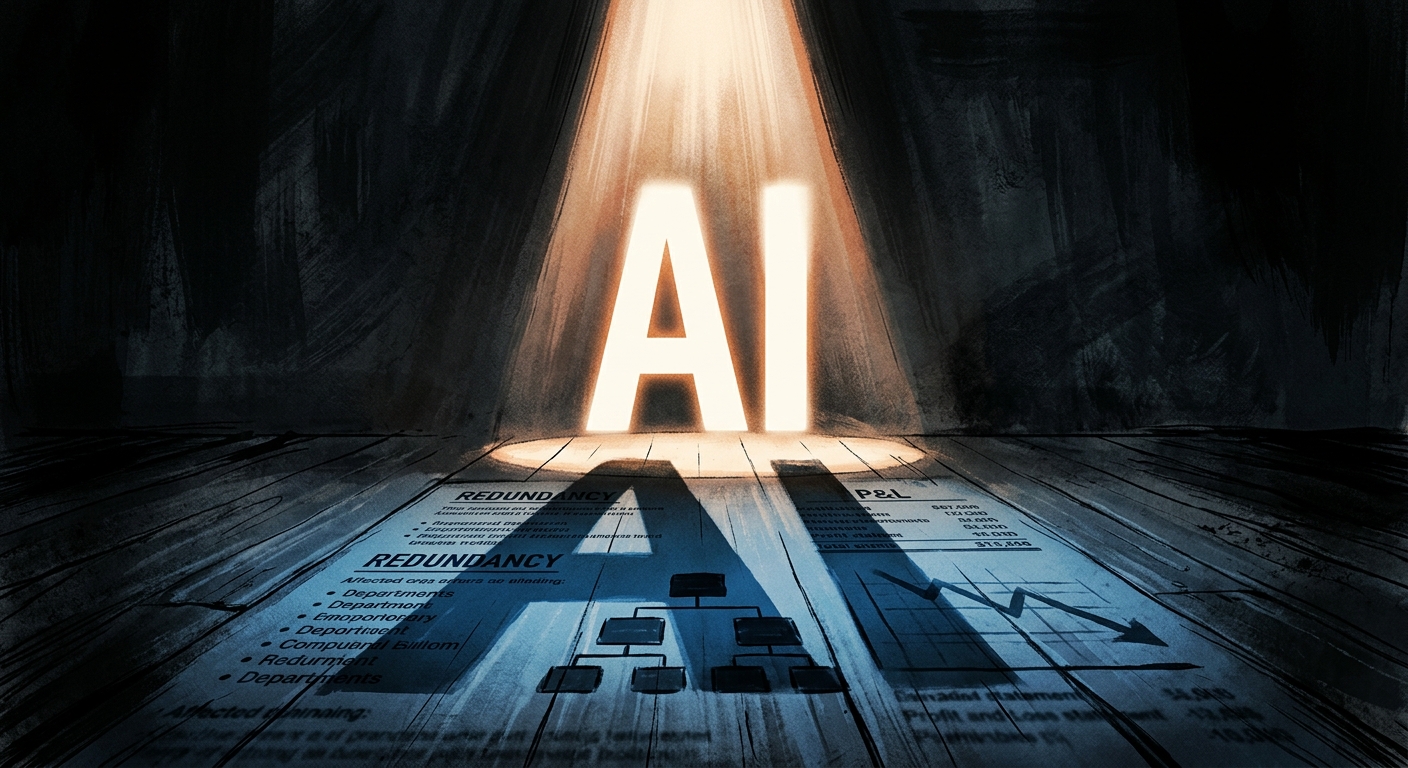
Two things are happening at once. First, AI productivity is real for specific workflows and starting to show up in unit-cost reductions. Second, “AI” is becoming the public-facing rationale for cost actions that boards and CEOs have wanted to take for other reasons — overhiring during 2021–2022, deteriorating margins in slower-growth segments, restructuring to a target operating model that was already in motion. The two stories overlap, and the public communication does not distinguish between them.
For employees, the framing matters because “we are restructuring” and “AI is replacing your role” carry different signals about whether the function comes back. For investors, it matters because the market is pricing AI-cited cost reductions as durable while restructuring-cited cost reductions are typically priced as one-off. CEOs who choose the AI framing get a multiple uplift. That incentive structure tells you why the framing is becoming dominant.
Andreas’s view
My read on this: the next 12 months will see a steady drift toward AI-as-explanation in layoff communications, regardless of whether AI is the underlying driver. The reason is not deception — it is signaling. CEOs need a forward-looking story that the cost base will stay reduced, and “AI productivity” is a cleaner story than “we hired too aggressively in 2022.” The public record will eventually reconcile this; quarterly earnings will reveal which companies actually shipped the productivity gain and which simply downsized.
I don’t think the workforce numbers are yet the right metric to watch. The right metric is the ratio of revenue per employee in the months after the cut. If revenue per employee climbs durably, the AI framing was substantively correct. If it plateaus or reverses while operational quality declines, the framing was a positioning move and the company will be hiring back inside 18 months — at higher cost and lower morale.
The way I see it: when a CEO presents an AI-cited workforce action, the productivity model behind it should be specific enough to name which workflows, which output measures, which time horizon, and which control group. Where those answers are vague, the action is restructuring with AI vocabulary. That is not necessarily wrong, but the distinction matters — and I think it matters most at the board level, where the conversation should reflect what is actually driving the decision.
Three things I’m watching
Three things I’m watching as this plays out:
- I’ll be watching whether companies maintain a clear internal distinction between AI-driven productivity actions (with a workflow-level model behind them) and AI-framed restructuring actions (justified by other reasons). Both can be valid; conflating them confuses execution, and the ones that keep the distinction clean are more likely to deliver what they promised.
- The companies that track revenue per employee monthly for the 12 months following any AI-cited workforce reduction will have the clearest view of whether the productivity gain actually materialized — and I’ll be looking at that number as the most honest signal in the public record.
- I’ll be watching how specific companies get in their external communication around AI-related workforce changes. Vague “AI is making us more productive” framing tends to erode credibility internally faster than a precise statement of which work has been automated and which has been redesigned — and over the next year, that credibility gap will start showing up in retention and hiring data.
References and related signals
- HBR: Companies are laying off workers because of AI’s potential — not its performance
- CBS News: more companies pointing to AI as they lay off employees
- Challenger, Gray & Christmas: monthly job-cut report (AI as leading reason)
- Programs.com: tracking list of companies announcing AI-driven layoffs
- Related signal: Block’s 4,000-job cut a few days later (Feb 26) made the AI-as-narrative pattern explicit at scale and tested the market reaction.