What was announced
At CES 2026 in Las Vegas (Jan 5–9), a cluster of robotics announcements crossed the same threshold in a single week. Boston Dynamics unveiled the production-ready electric Atlas with Hyundai committing the first fleet to its Metaplant in Savannah, Georgia, and announced a partnership with Google DeepMind to integrate Gemini Robotics models into the platform. LG demonstrated CLOiD performing real household work — laundry, dishwasher loading, food preparation — in a staged living environment. EngineAI introduced the T800 with a $25,000 starting price and mid-2026 shipping. CES listed 40 companies referencing humanoids on the show floor.
What it means
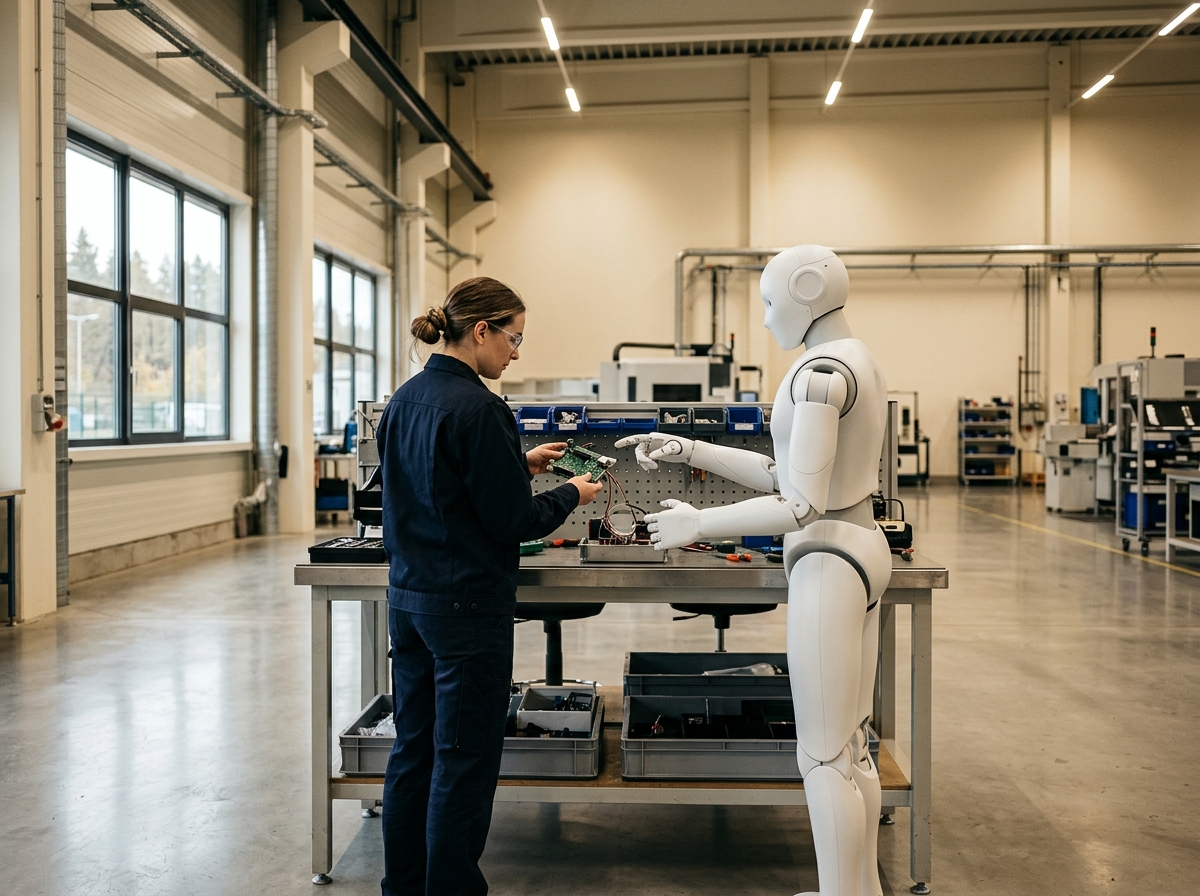
For three years humanoids were a category of demo videos. CES 2026 is where the category became a category of contracts. Production is committed, factories are named, prices are listed, and the foundation-model layer (Gemini Robotics, comparable initiatives at other labs) supplies the cognitive component that previously made every demo brittle. The constraint is no longer “can it walk on stage.” The constraint is “what does the deployment workflow look like, and who owns the integration.”
From this follows a second-order effect: industrial buyers now have a real procurement question to answer in 2026 — not in 2030. Hyundai’s timeline (Atlas at Metaplant, dedicated robotics factory targeting 30,000 units per year by 2028) is the explicit benchmark. Every competing automaker, every large logistics operator, and every contract manufacturer now sits with a known reference deployment to react to.
Andreas’s view
My read on this: the news is not that the robots are good enough. The news is that buyers have decided they are good enough to commit — and the price has moved into range. At $25,000, a humanoid sits below the annual cost of an industrial worker in most developed markets. That shifts the question from “is this technology real” to “where does it amortize fastest.”
My three takeaways:
1. The barrier that fell was cognitive, not mechanical. The hardware has been close to ready for years. What changed is that foundation models — think Atlas plus Gemini Robotics — absorbed the cognitive deficit that kept robots out of unstructured environments. CES 2026 looks different because the system is different, not just the chassis. I think anyone framing this as “better robots” is underestimating the speed of what comes next.
2. The 2030 humanoid timeline is already stale. In my view, this is now a 2026 pilot conversation for any organization with manufacturing, warehousing, or fulfillment in its operations footprint — anywhere unit-level labor is the dominant cost driver. Not as a capex bet, but as a learning investment. The compounding advantage goes to whoever builds operational muscle around these systems first.
3. The real cost of waiting isn’t hardware — it’s the operating model. Hardware will be available to everyone. What won’t be available off the shelf is three years of deployment experience. My expectation is that late movers won’t just be buying machines from competitors — they’ll be importing the playbook for how to use them.
References and related signals
- CNBC: Humanoid robots take over Las Vegas at CES 2026
- Engadget: Boston Dynamics unveils production-ready Atlas at CES 2026
- SiliconANGLE: Hyundai and Boston Dynamics join forces on humanoid factory deployment
- Interesting Engineering: nine humanoid robots that defined CES 2026
- Related signal: NEURA Robotics (Porsche-designed Gen 3), Richtech Dex, AGIBOT industrial humanoids — same week, same pattern.