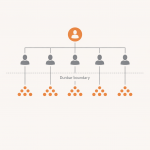
Team sizes are not design choices. They are cognitive limits. The recurring numbers that show up in military units, religious communities, hunter-gatherer bands, and commercial organizations are not management philosophy. They are a property of the animal doing the work, and any organizational structure that pretends otherwise pays a measurable tax in friction, communication overhead, quiet attrition, and decisions that arrive three weeks late.
Two. Four to six. Eight to twelve. Twenty to twenty-five. Fifty. One hundred and fifty. The specific numbers recur across centuries and industries. In the Roman legion and the US Marines. In religious communities and hunter-gatherer bands. In tech companies, sales organizations, and the advice experienced managers give each other about when to split a growing team. It is not a coincidence. It is cognitive architecture. The constraint is no longer technology. The constraint has always been the brain doing the coordinating.
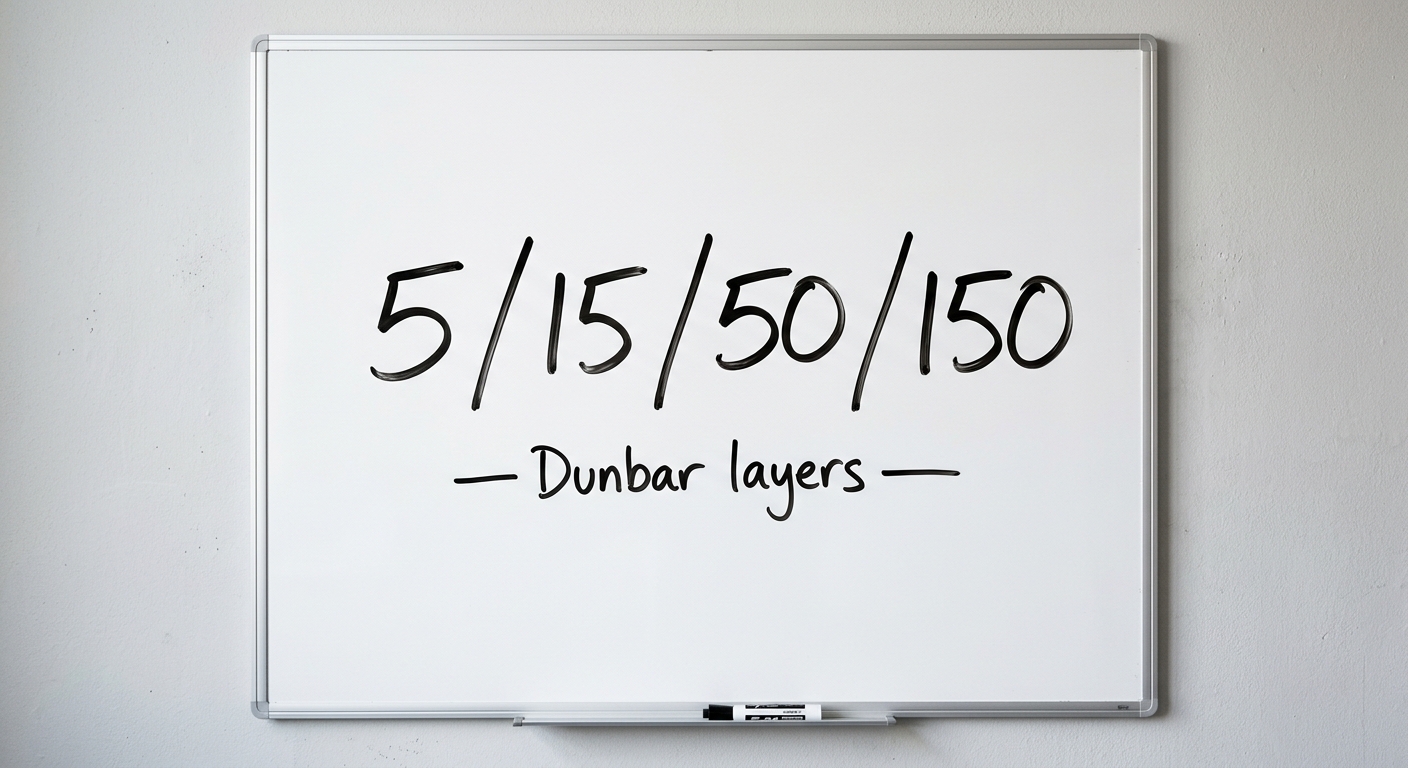
Dunbar’s layers
The research most commercial leaders eventually bump into is Robin Dunbar’s. Dunbar is a British anthropologist who, in the early 1990s, proposed that the size of a primate’s social group is constrained by the size of its neocortex. Extrapolating from primate data, he estimated the human number at around 150 — the number of people with whom any one of us can maintain a stable, recognisable, mutually-active relationship. He published it in the Journal of Human Evolution in 1992, and the number has been running through management literature ever since.
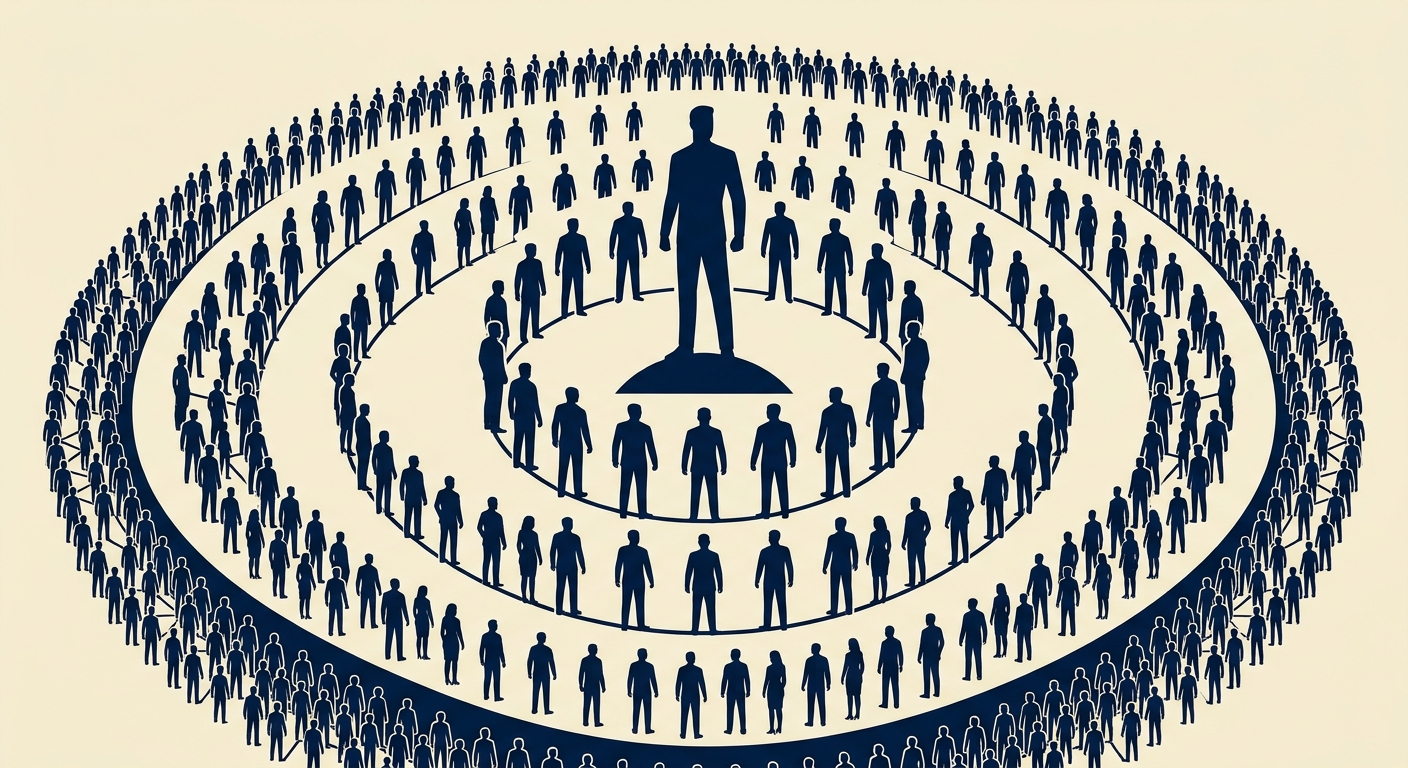
The part that gets talked about less, but matters more, is that Dunbar’s 150 is not a single flat layer. It is the outer ring of a nested set, each layer roughly three times larger than the one inside it:
- ~5 — your closest support group. The people you would call in a real emergency.
- ~15 — your sympathy group. People whose loss would significantly affect you.
- ~50 — your band or clan. People you know well enough to share deep context with.
- ~150 — your active community. Stable, recognisable, mutually reciprocal relationships.
- ~500 — acquaintances.
- ~1500 — faces you can still recognise.
These layers show up in the research almost regardless of whether the subject is a tribal society, an office workforce, or a social-network friend graph. And they map astonishingly well onto the team sizes that commercial organizations stumble toward by trial and error — not because anyone read Dunbar, but because the alternatives don’t work.
The military got there first
Armies have been experimenting with how to organize humans under extreme stress for two thousand years, and they arrived at exactly these numbers through pure selection pressure. Smaller was too fragile. Larger fell apart under fire. The numbers that survived are the numbers that work.
A Roman legion’s smallest unit was the contubernium — eight soldiers who shared a tent, a mule, a mess, and most of their waking life. Eight. Right at the boundary between the 5-person inner layer and the 15-person sympathy group. The Romans knew nothing about neocortex ratios. They noticed that a group of eight held together in a way that a group of four or a group of sixteen did not.
The modern US Marine Corps fireteam is four. The squad is roughly 13. The platoon is 30 to 40. The company is 100 to 150. The same ratios, twenty-one centuries later. The cognitive limits haven’t moved, because the brain they are about hasn’t.
The tech industry rediscovered the same numbers
The technology industry discovered the same structure and gave it different names.
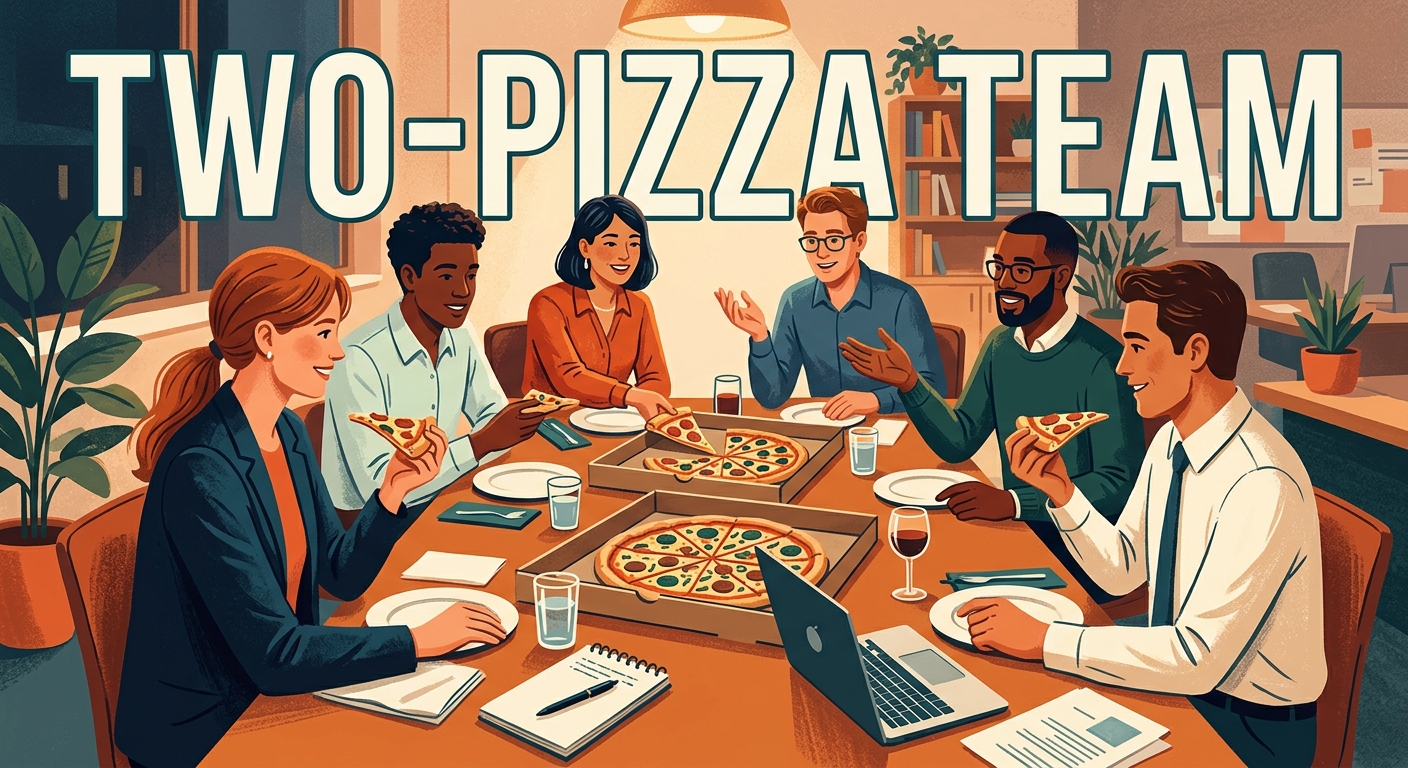
Jeff Bezos’s two-pizza rule — a team should be small enough to be fed by two pizzas — is a practical restatement of the 5-to-8 cognitive sub-layer. Amazon did not get there via anthropology. They got there by watching their own product teams stall every time they grew past the point where the whole group could fit around one table.
Scrum teams are officially 7 ± 2 — the current Scrum Guide recommends 3 to 9 members — which echoes George Miller’s 1956 paper on the working-memory limit of around seven chunks. Miller was not writing about teams. The cognitive limit he found on how many things we can juggle at once maps cleanly onto how many people we can coordinate without losing track of where everyone is.
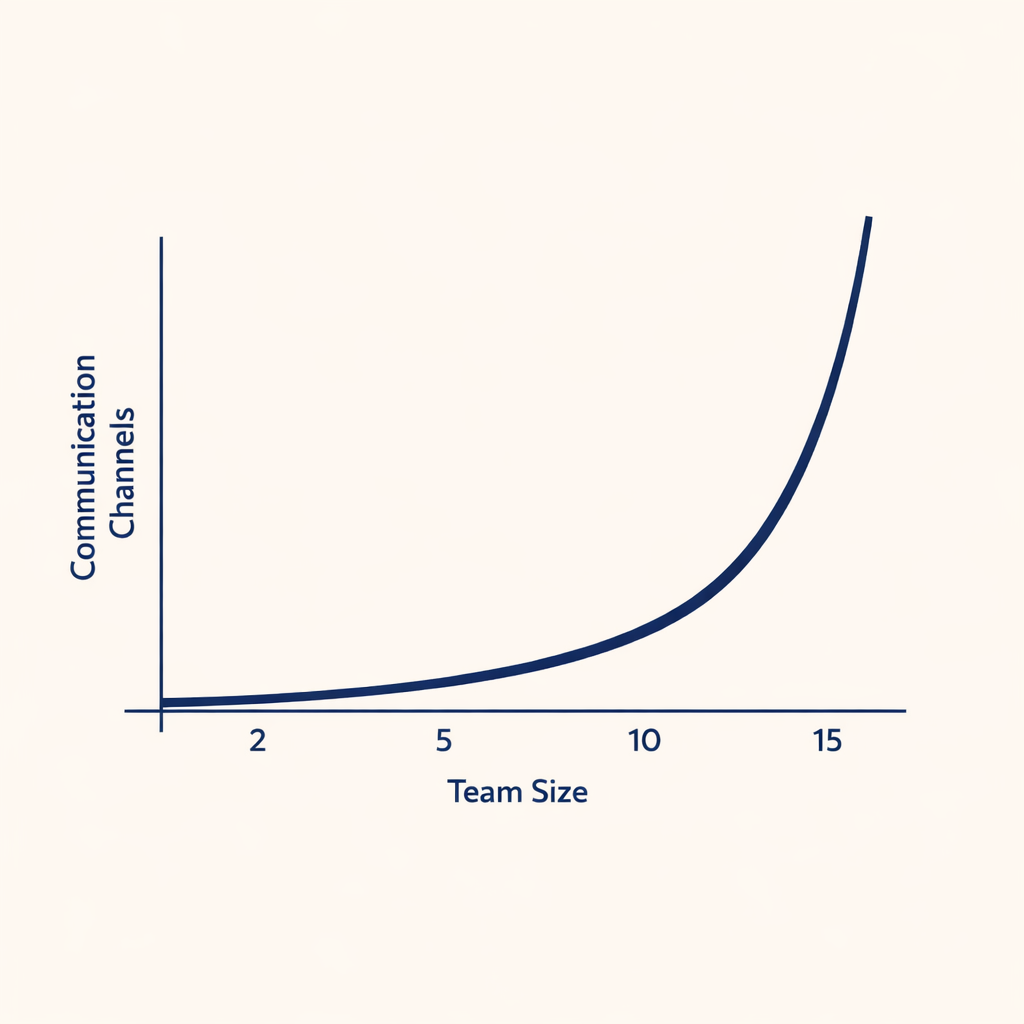
Fred Brooks, in his 1975 book The Mythical Man-Month, observed that adding people to a late software project makes it later, because every new person increases the number of pairwise communication channels by roughly n(n–1)/2. Seven people means 21 channels. Ten means 45. Fifteen means 105. The coordination tax is quadratic, and it surfaces as “mysterious” slowdowns at exactly the team sizes where the math stops being manageable.
W. L. Gore & Associates, the Gore-Tex company, built Dunbar’s number directly into its real-estate strategy. Founder Bill Gore had a rule: every time a building exceeded 150 employees, they built another building. He was running Dunbar’s ceiling inside his facility planning decades before Dunbar had published the paper.
The Ringelmann effect, documented in 1913 and one of the oldest findings in social psychology, is the same story in a different register: as group size grows, the effort each individual contributes goes down. People pull harder on a rope when there are fewer of them holding it. Max Ringelmann measured it with actual rope-pulling experiments, and the finding has been replicated many times since in workplace and sports settings.
The role change: the first-line manager span is a cognitive limit, not a cost line
A first-line manager’s direct-report span is not a matter of preference for most cognitive work. It sits around 5 to 7. Push it to 10 and managers stop coaching and start triaging. Push it to 15 and the role has reverted to being an individual contributor with a different title. Organizations that scale cleanly keep that first layer tight even when the spreadsheet says it is expensive — because the spreadsheet is not pricing the coordination tax that a wider span produces downstream.
The org change: 50 and 150 are hard boundaries
The sub-team that actually owns a piece of work should be closer to 5 than to 10. Not because small teams are faster in principle, but because the communication-overhead curve gets steep fast after 7. Bezos was right about this, and almost every high-performing team of any reasonable size runs its real work through an informal group of four or five — regardless of what the reporting structure says on the org chart.
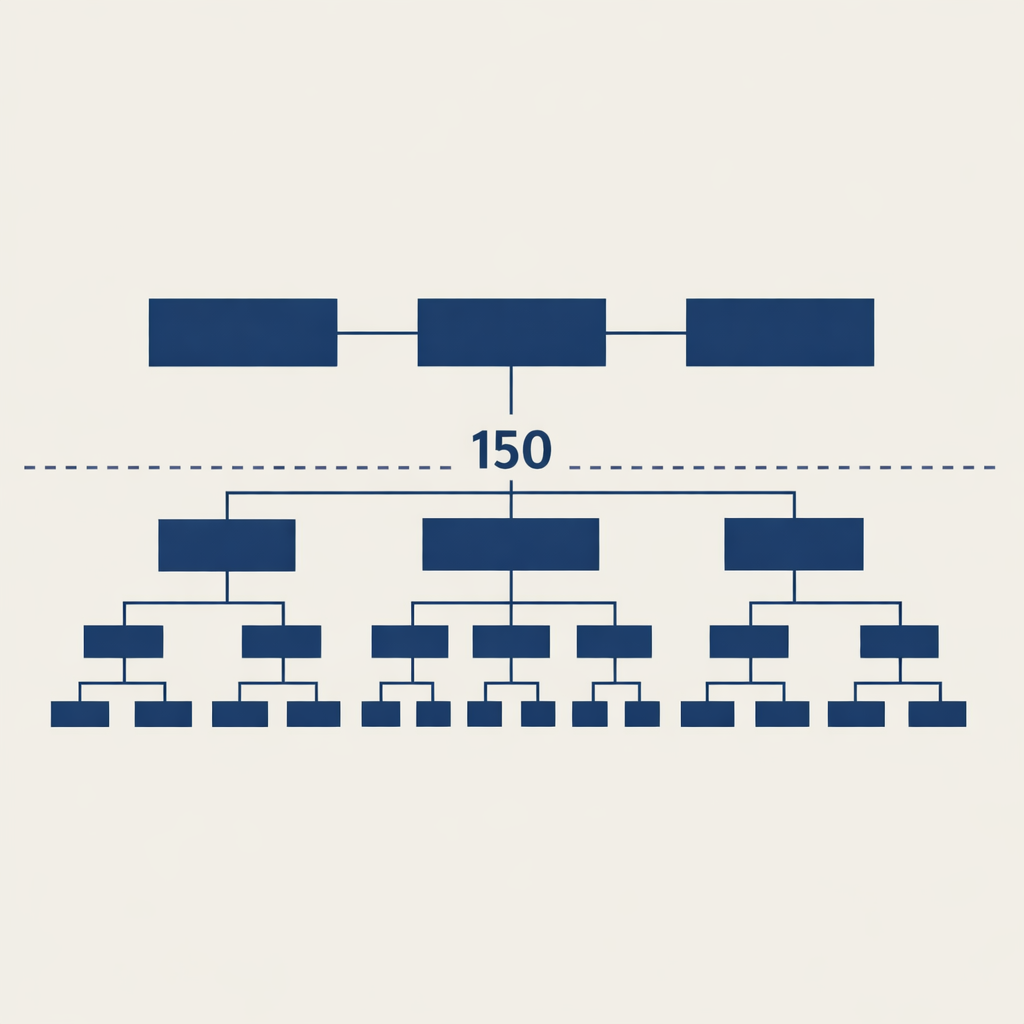
When a function crosses 50 people, it needs an operational substructure. Tribes, chapters, pods, whatever the label — or the Dunbar sympathy layer breaks. When the people in a team stop knowing each other well enough that a death in someone’s family would visibly register with everyone, culture starts dying quietly. By the time anyone notices, six months have usually been lost.
When an organization crosses 150, it runs two cultures whether the leadership admits it or not. The question is only whether the split is designed deliberately or happens by default. Organizations that handle the ceiling well accept it and build deliberate boundaries. Organizations that handle it poorly spend years pretending 400 people are “all one team.”
The strategic consequence: org design is surrender, not construction
Good organizational design is mostly a process of surrender. The cognitive architecture of the humans running the teams picks team sizes for you, and the only real choice is whether to build the org chart around what actually works or to fight it and pay the tax. Every commercial organization that has tried to force a bigger number — a 12-person manager span, a 30-person “small team,” a 300-person “family culture” — has either quietly subdivided itself into groups that look suspiciously like the Dunbar numbers, or lost the thing that made it work.
AI augmentation does not move the cognitive ceiling. It moves the throughput below the ceiling. An IC managing four AI agents is still operating inside a span of four. A manager coordinating seven sub-teams of augmented ICs is still operating inside a Dunbar-5 layer. The numbers that governed organizational design before agents are the numbers that will govern it after.

So what boards should do
Boards should design operating models around the Dunbar layers and treat AI-augmented throughput as a multiplier on what each cognitive unit can do — not as a license to stretch the unit past its ceiling. The specific actions sit at four layers: first-line spans at 5 to 7 even under headcount pressure; sub-team ownership at 5; operational substructure at 50; deliberate cultural boundaries at 150. These are not target numbers. They are discovered numbers. Every other structure is an argument with biology, and biology does not negotiate.
The Roman legions did not know about neocortex ratios. The Marines do not design their fireteams around anthropology papers. Jeff Bezos did not cite Dunbar when he ordered the pizzas. All three converged on the same numbers because the numbers are a property of the animal doing the work, not the work itself. The job of an organizational designer is to notice this — and then get out of the way.
References
- Dunbar, R. I. M. (1992). “Neocortex size as a constraint on group size in primates.” Journal of Human Evolution.
- Dunbar, R. I. M. (2010). How Many Friends Does One Person Need? Harvard University Press.
- Miller, G. A. (1956). “The Magical Number Seven, Plus or Minus Two.” Psychological Review.
- Brooks, F. P. (1975). The Mythical Man-Month: Essays on Software Engineering.
- Hackman, J. R. (2002). Leading Teams: Setting the Stage for Great Performances. Harvard Business School Press.
- Ringelmann, M. (1913). Early social-loafing experiments, Annales de l’Institut National Agronomique.
- Gladwell, M. (2000). The Tipping Point. Popularised Gore’s rule of 150 for the management audience.
- The Scrum Guide — current recommended team size: 3 to 9 members.