

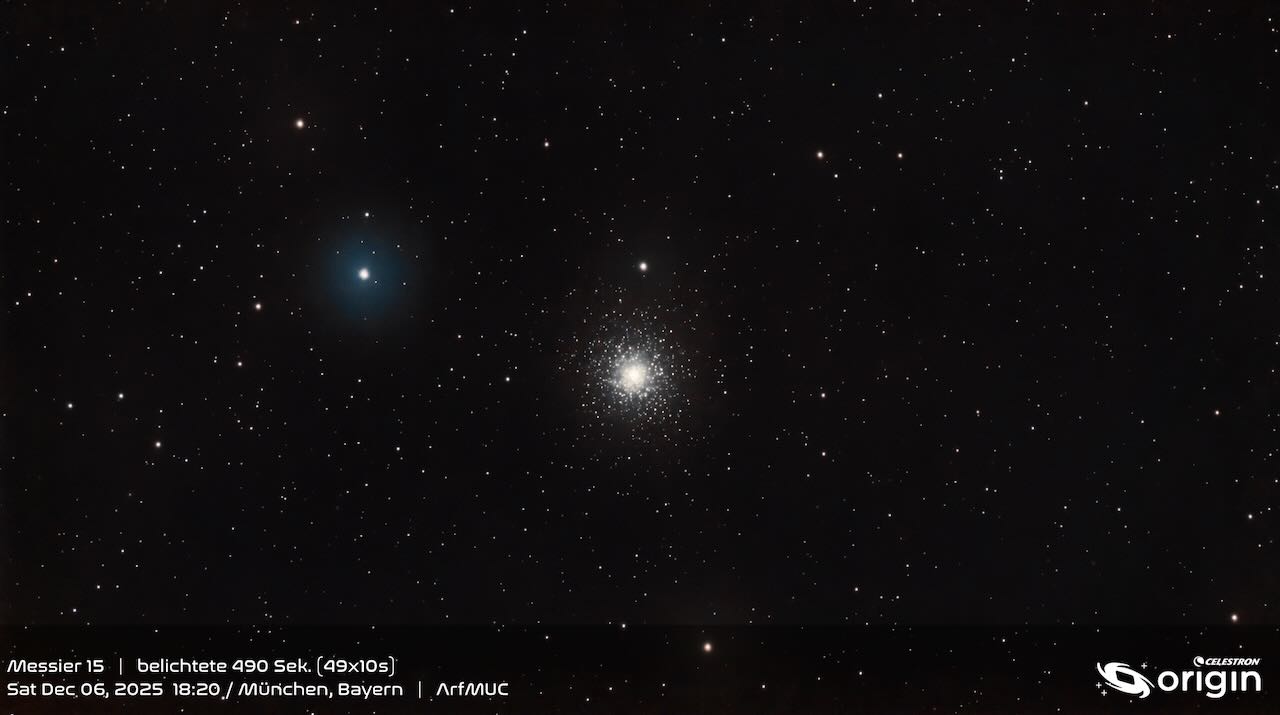
My first brief test under Munich’s cloudy Bortle-5 sky, capturing two quick targets—Messier 2 and Messier 15—during a rare break in the weather.
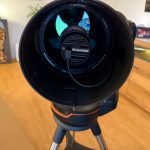
After what felt like weeks of terrible weather in Munich, I finally caught a tiny window—a few short minutes without clouds. Not great conditions by any means, but after so many overcast nights, this brief opening felt like a small victory. Under my usual Bortle 5 suburban sky, I rolled out the Celestron Origin Mark II for its very first test.
Despite the haze, moisture, and constant threat of new cloud banks, I managed to capture two quick targets, both fully processed directly on the Origin: Messier 2 and Messier 15. It wasn’t the perfect first-light session I imagined—but it was enough to get a taste of what this smart observatory can do even under tough skies.
Messier 2 – 55,000 Light-Years Away
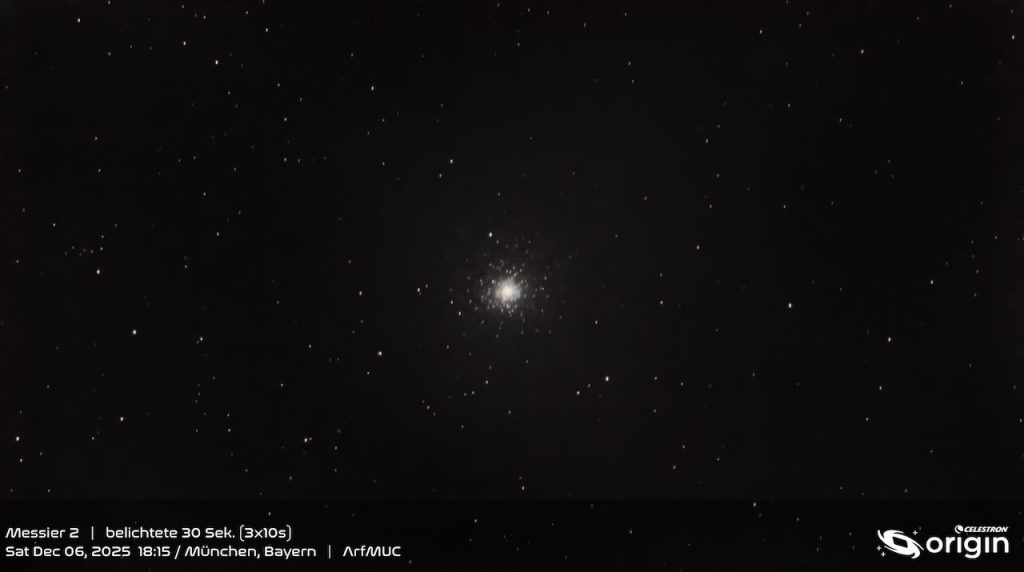
Messier 2 is one of the oldest and largest globular clusters in the Milky Way. It sits roughly 55,000 light-years from Earth, which means the photons hitting my Origin Mark II left the cluster when early human cultures were just beginning to form permanent settlements.
This was just a first test shot, and I only took three 10-second exposures. Especially with the poor conditions, that’s nowhere near enough frames to stack into a truly good photo—you normally need far more images to build detail, reduce noise, and bring out the full potential of a deep-sky object.
Messier 15 – A Core on the Edge of Collapse
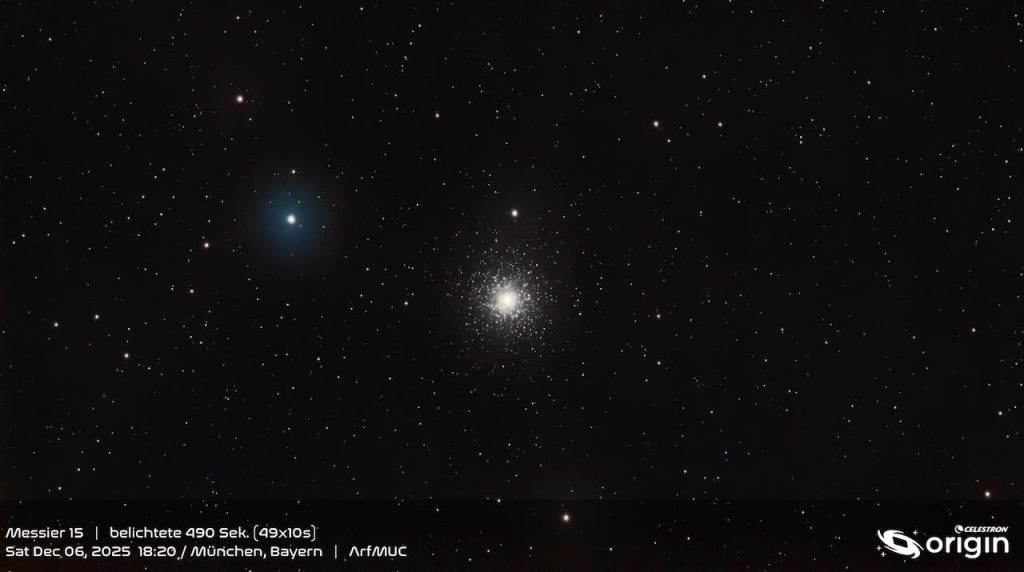
Messier 15 is even more dramatic. Located around 33,600 light-years away, the light captured by the Origin started its journey long before the Bronze Age, crossing the galaxy for more than 30,000 years before reaching my camera in Munich.
M15 is estimated to contain over 100,000 stars, and what makes it truly special is its core-collapse structure—one of the densest of any known globular cluster. Astronomers even suspect a black hole or a dense concentration of neutron stars at its center.
For M15, I captured 49 individual 10-second exposures, and the difference is immediately noticeable—the final image is much sharper and reveals significantly more detail. All stacking and processing were done directly inside the Origin.
The weather may not have cooperated, but this short session was enough to confirm that the Celestron Origin Mark II is a powerful tool—especially for nights where every clear minute counts. I’m already looking forward to the next proper clear night, hopefully with longer exposures, more objects, and a real chance to see what this instrument can do under better skies.
Clear skies—hopefully soon!

Leave a Reply
You must be logged in to post a comment.